Ontogeny Recapitulates Phylogeny, or: the Overtone Series as a Basis for Warm-Ups and Essential Technique
By Jeffrey Agrell
Ontogeny Recapitulates Phylogeny: the theory in biology that development of the embryo retraces the evolutionary development of the entire species. Although this theory has proved not to be true, I nevertheless fastened on the idea that it might have something to offer us when translated to horn playing. Let’s take a quick scan over horn history how we might apply the theory and use the significant events of horn history to inform how a horn player might structure his/her practice today.
Brass playing may have had its earliest roots in an accident many thousands of years ago when someone happened to stumble over the horn of an ancient oryx, kudu, or eland, and, in trying to blow the dust out through the broken tip, had his lips set in vibration – imagine his surprise at the mighty blast! This short horn was capable of only one or two notes, but for many centuries, that was sufficient for the purposes of signaling for the soldier or the hunter. Brass playing as we know it began to take shape in about the fifteenth century, and in the sixteenth century the horn (now made of brass tubing) started to grow in length and be coiled. This longer instrument was capable of producing more (playable) overtones of the Overtone (or Harmonic) Series, which can be numbered from the fundamental:

Players learned to use the air and embouchure to pick out selected overtones and thus play melodies. Different keys were achieved by adding different lengths of tubing, called crooks. By 1750 the system of producing all notes of the chromatic scale through the technique of hand stopping had been codified and widely taught. Valves were invented in 1815, although at first they were seen simply as a way to change crooks quickly since the main technique was still hand horn. Although the French were notable holdouts, as the nineteenth century went on, players began using the valves as we do today to move quickly from note to note. The F/Bb double horn was invented by Kruspe in 1897. In the twentieth century, knowledge of the horn’s historical valveless technique gradually slipped away as players spent almost all their time thinking of fingering (valve technique) and less in terms of different horn keys and overtone series.
Let’s take each element of history (~phylogeny) and experiment how we might use it to structure a player’s practice (~ontogeny).
Playing begins with a first tone. Our version is going to be much more refined than that Ur-oryx blast. Our first tone may be a buzz on the mouthpiece, something controlled and comfortable, like a waver-free long tone in the middle register. The mouthpiece is the producer of sound (the horn is really just an amplifier) and is merciless in what it reveals (the horn is much more forgiving – believe it or not). We can also try short scales, intervals, and glissandos on the mouthpiece as we warm up and recalibrate the process of brass playing.
Early players produced all tones without valves, acquiring great skill in the control of air and embouchure to get around the overtone series. Much more of horn history was valveless than valved. Applying our theory, it is clear that it would behoove us to spend a significant amount of time playing “natural” horn only, i.e. playing only on the overtone series before we add valve technique. Let us do as the early players did, enjoying the added advantage of being able to play successively on the overtone series of many horns.
What we call the double horn is actually fourteen horns of different lengths (i.e. one for each unique fingering). Each length has the same overtone series [OTS] as above, just beginning on a different pitch and thus playing in a different key. For warm-ups and the development of technique it is very useful to repeat overtone series exercises on each “horn.” It is also useful to think in terms of playing in each different key of horn rather than just the fingering for each.
Below are listed all of these different horns with the fingering (i.e. length of tubing) required to produce each key (omitting the two overlapping keys). In brackets is the equivalent note on the F horn.
F side (descending)
F horn = 0 [middle C]
E horn = 2 [B]
Eb horn = 1 [Bb]
D horn = 12 [A]
Db horn = 23 [Ab]
C horn = 13 [G]
B horn = 123 (F#]
Bb side (ascending)
Gb horn = T23 [Db, a half step above F horn = 0]
G horn = T12 [D]
Ab alto horn = T1 [Eb]
A alto horn = T2 [E]
Bb alto horn = T0 [F]
To apply our theory, we need to invent exercises to aid in mastering movement around the overtone series. There are nearly limitless variations possible, but knowing some basic principles can help us quickly set up some practical exercises for daily warm-ups and technique training. There are three basic kinds of OTS exercises: adjacent note (where you move from one note on the overtone series to the next one), nonadjacent or “leap” exercises (where you jump over one or more OTS note), and mixed exercises with both adjacent and nonadjacent movement.
Many method books feature OTS exercises, but most of them follow one rule that follows mistaken logic: they use arpeggios that fit music theory rather than the way the instrument works. That is, they avoid the “out-of-tune’ harmonics 7 and 11 in order to produce ‘pure’ major arpeggios. It makes more ‘horn sense’ to spend time first mastering adjacent note movement – including OTS 7 & 11 - before adding the more treacherous leaps. To refer to our analogy, an embryo’s development is continuous, moving seamlessly from one stage of development to the next in very small steps – no skipping ahead!
Many of these OTS major scale arpeggios in existing method books also immediately span the entire range of the horn. For the purpose of warming up and recalibrating it makes more sense to begin with narrower arpeggios in the middle range and then gradually extend the range in both directions. How quickly a wide range is achieved depends on the player’s skill, experience, and perhaps the condition of the chops today, right now. Whatever our level, we can “recapitulate” the development of range and technical skill each day at our own rate. Slur all exercises at first; later use a variety of articulations. Begin comfortably, slowly and accurately; increase speed gradually as proficiency develops. Spending one-half to three-fourths of your first session on OTS exercises pays big dividends. NB: don’t write out the exercises any more than necessary – learn the principles and then create exercises from them on the spot each day. You’ll save paper and the exercises will ‘”fit” you much better. Creating the exercises this way also has the advantage of variety – you can make them a bit different every time while getting the same musical and technical “vitamins” and not become bored and inattentive playing the same exercises every day, day after day.
One more thing: the OTS exercises of many method books use only the F side of the horn. There is no reason not to do them all on the Bb side as well, since that is where we spend the lion’s share of our playing time. Thus: all exercises should be done in all keys on both side of the horn.
Adjacent OTS note exercises
The journey of a thousand miles begins with a single step. It makes sense to begin with something that we can play easily, accurately, and without tension. It is very important to be concerned with the process of proper playing and not force the product (e.g. using left hand pressure to force high notes). Begin where everything is easy, then maintain that feeling as you gradually expand the challenges (range, dynamics, tempo, articulation, etc.). An appropriate place to start might be two notes in the middle range.
1. Two notes. Start by simply going back and forth between two adjacent overtones as smoothly and efficiently as possible. Close your eyes; be aware of the sensation. Speed should be slower to start; then gradually increase tempo as proficiency develops - to the point of trilling or tremolo. Example: OTS steps 5 to 6 (shown below), 6 to 7, 4 to 5. Note that this “shape” becomes what we will later practice as a lip trill when we move it to OTS steps 8-9. Take this exercise through all “horns” available, i.e. horns in C, Db, D, Eb, E, F, Gb, G, Ab, A, Bb alto.

2. Three notes. After a two note warm-up and recalibration, we begin to add notes. Start with an up-and-back triplet shape on the lower two followed by the same on the upper two. Then play up-and-back on all three. Over time, experiment with moving this 'frame' of three up and down the OTS. The higher the OTS numbers, the smaller the intervals between the notes. Once again, take the shape through all horns (keys).
A comfortable place to begin is OTS notes 4 5 6. Two variations are shown here: OTS 4545 6565 and 3454. There are more possibilities: discover them!
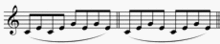
3. More than three notes. Extend the above examples over wider ranges and create new combinations. Examples: OTS notes 4-5-6-7-8; 5-6-7-8-9-10; 8-9-10-11-12 – this group (written C5-G5) is especially rich with possibilities, since it is part of a major scale (well, almost –the 11, usually written as F#, sounds halfway between F and F#). Octaves also make excellent practice ranges (e.g. 4 to 8, 5 to 10, 6 to 12, 8 to 16).
Sample exercises using OTS notes 8 through 12 on the C horn [F: 13]:

As with all of these exercises, take this one through all horns on both sides of the double, from C basso (shown; F: 13) to Bb alto (Bb: 0), which has a top note of high C (C6 [c’’’]). And, as with all exercises, don’t force it. Play up through as many “horns” as is easy and comfortable using air and embouchure without help from the left arm, and stop there – don’t force the upper register. Keep at it, keep coming back, keep observing the process and it will come.
4. Glissandos. Speed up octave exercises to make OTS octave glissandos in all ‘horns,’ in all registers. Start with one octave (e.g. C4-C5 = OTS notes 4 to 8, F: 0) and go up (and/or down) by half steps. Later make it an octave and a half, then two, and finally three octaves. Eventually you will find yourself able to do octave glissandos that end considerably above high C, but it should always come easily. At no time should you force the top notes. Development and progress take time, and everyone progresses at their own rate. When the top notes don’t happen, stop, rest, and try again later.
Nonadjacent OTS exercises (leaps)
When moving from overtone to overtone starts feeling fluent, controlled, and easy, start adding leaps to your program. Leaps are simply very fast glissandos where you elide quickly and cleanly over the middle note(s). Practice slurred leaps both ascending and descending.
1. Start with basic, short (two-note), midrange leaps. Examples: OTS #s 4-6, 6-8, 6-8, 6-9, 8-10. For yourself make a chart of all possible two note OTS leaps. Select one or more each day, beginning with narrower leaps and gradually progressing to wider and wider intervals.

2. Combine several of these to make longer exercises. Examples: OTS #s: 3-5-4-6 (also practice it inverted: 6-4-5-3), 8-10-9-7.
3. Add leaps of several OTS notes. Combine freely with two-note leaps, which will often make it easier to play normal triads. Examples: 4-6-5-8, 5-10-8-12.
Mixed Adjacent and Nonadjacent OTS exercises
This means playing arpeggios using a mix of adjacent and nonadjacent notes (OTS number leaps). As the notes grow progressively closer together in the upper register, one or more OTS notes will have to be skipped to maintain a regular arpeggio. Practice both stepwise motion (scalar) and leaps (e.g. major triad) in OTS notes 8 and above, especially #s 8-12. Increase speed as facility develops.
Additional Study
•Practice diatonic sequence patterns (“shapes”) on the OTS, especially from OTS #8 on up. Example: Down One and Back: an ascending sequence for the OTS 4 to 8 octave (C4-C5) would be (in OTS numbers): 4 3 4 5 4 5 6 5 6 7 6 7 8. Descend using the inverted shape: 8 9 8 7 8 7 6 7 6 5 6 5 4 5 4. Move this shape up and down in octaves for practice in all registers. Discover more such patterns and put them to use.
•Play simple diatonic folk tunes that can be played using only the OTS.
•Review OTS exercises in books by Wendell Rider, Frøydis Ree Wekre, Fred Teuber, Douglas Hill, Philip Farkas, Louis Dufresne, Sam Pilafian, and others. as well as books for the other brasses to build a vocabulary of possibilities. Be inspired and invent your own exercises and combinations. With some imagination your OTS workout can be fresh and new every day.
Valve technique?
Our analogy must stop for reasons of space with an overview of the development of technique using the overtone series. Another analogy from another science might say that the overtone series is the operating system and the valves are the user interface. After a thorough grounding in the ways and wonders of the negotiation of the OTS, valve technique will come a lot quicker, since technical problems are often due to an underlying deficiency of skill getting around the OTS and not with valve technique. Thus, the sooner the player acquires fluency and consistent accuracy in moving around the OTS, the quicker advances in valve technique will come.